Anyone buying stainless steel tubes is really buying three things: the material, the documents that prove its properties, and the assurance that the two belong together. A trader sits between mill and end user. It does not make the tube, but it decides where to buy, how to check certificates, how to match heats to deliveries and what happens when something is wrong.
Those decisions are exactly what a quality management system to DIN EN ISO 9001:2015 governs. Schierle Siyaya has been certified by TÜV Rheinland since June 2026, less than a year after the company was re-established. This article explains what the certificate actually covers for a steel trader, why the certification body matters, and what customers and suppliers gain.
Key facts at a glance
- Certified: DIN EN ISO 9001:2015, TÜV Rheinland Cert GmbH, registration no. 01 100 2500992, valid until 17 June 2029, publicly verifiable on Certipedia under ID 9000042577.
- Scope: trading of stainless steel tubes and the related consulting and processing services.
- What it means: supplier selection, order review, certificate checking, traceability, handling of nonconformities and complaints follow documented, audited procedures.
- What it does not mean: ISO 9001 certifies the system, not the individual tube. Product quality is still evidenced by mill certificates to EN 10204 3.1 or 3.2 and the agreed tests.
- Why TÜV Rheinland: a DAkkS-accredited certification body, annual surveillance audits, recertification every three years, international recognition.
What does ISO 9001:2015 actually mean for a steel trader?
ISO 9001 is often associated with factories. For a trader the standard is at least as relevant, just in different places. These are the requirements that make the difference in stainless steel tube trading:
- Supplier evaluation (clause 8.4): mills and sub-suppliers are selected, evaluated and periodically re-evaluated against defined criteria. Who supplies is a documented decision, not a habit.
- Order review (8.2): before confirmation, grade, dimension, standard, tolerance, delivery condition and test scope are checked for completeness and availability. Misunderstandings are cleared up before delivery, not after.
- Identification and traceability (8.5.2): every item stays linked to its mill certificate through the heat or batch number, from goods receipt to delivery note.
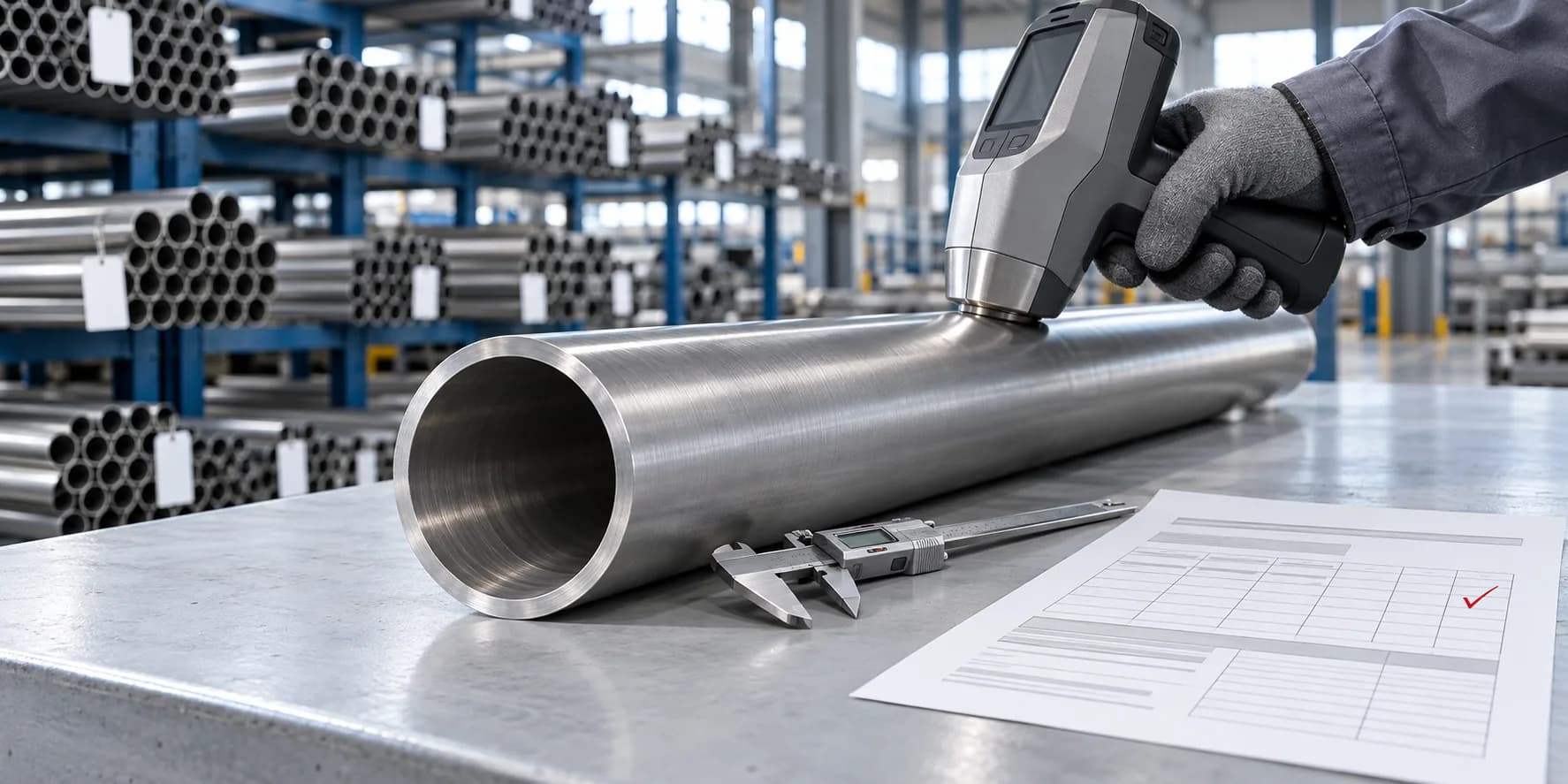
- Goods receipt and measuring equipment (8.6, 7.1.5): certificates are checked against the order, dimensions are sample-measured, measuring equipment is calibrated. PMI testing for material identification is available on request.
- Nonconforming products (8.7): deviations are blocked, labelled and documented. Nothing reaches the customer without a decision.
- Complaints and corrective action (10.2): every complaint is recorded, root-caused and closed with an action that prevents recurrence.
- Customer satisfaction and KPIs (9.1): on-time delivery, complaint rate and processing times are measured and discussed in management review.
The point is not that a good trader would skip these things without a certificate. The point is that with one they are verifiable, repeatable and independent of individual people.
Why certification by TÜV Rheinland matters
An ISO 9001 certificate is worth only as much as the body that issues it. Who did the auditing is therefore not a side issue.
- Accredited certification body. TÜV Rheinland Cert GmbH is accredited by the German national accreditation body DAkkS to DIN EN ISO/IEC 17021-1 for certifying quality management systems. DAkkS in turn monitors whether the certification body audits independently, competently and consistently.
- International recognition. Through the multilateral recognition arrangements between accreditation bodies (IAF MLA), an accredited certificate is recognised worldwide. For our customers outside Germany, in South Africa for example, that is decisive.
- Not a one-off stamp. The certificate is valid for three years. A surveillance audit takes place in each year in between, followed by a full recertification after three years. Anyone who no longer meets the requirements loses the certificate.
- Publicly verifiable. Every TÜV Rheinland certificate is listed in the Certipedia database. Ours is under ID 9000042577; validity and scope can be checked there at any time.
For customers and suppliers this means: our statement "we work to ISO 9001" comes with an auditor, a date and a number.
What customers gain from a certified trader
- Faster supplier approval. Many procurement organisations require ISO 9001 for admission to the approved supplier list. The certificate replaces questionnaires, self-declarations and often the on-site audit itself.
- Reliable documents. Mill certificates to EN 10204 3.1 or 3.2 arrive checked, matched and archived. Anyone who has to prove what was installed, for pressure equipment, plant engineering or food processing, gets an unbroken chain.
- Less incoming inspection on your side. What has been checked against defined criteria at our end does not need a full re-check at yours. That saves time in goods receipt and quality assurance.
- Predictable complaint handling. If something is wrong, there is a fixed procedure with an owner, a deadline and a root-cause analysis. You learn what happened and what changes.
- The same quality whoever handles the order. Procedures are documented. Holidays, illness or staff changes do not alter how your order is treated.
- Evidence for your own audit. You can list the certified trader as a qualified supplier and prove it to your customers and auditors with a registration number.
What suppliers gain from a certified trader
A quality management system works in both directions. Mills and sub-suppliers delivering to a certified trader benefit too:
- Unambiguous orders. Grade, standard, dimension, tolerance, delivery condition, test scope and certificate type are all stated in full on the order. Queries and wrong deliveries fall.
- Transparent evaluation. Suppliers are rated against traceable criteria: on-time delivery, document quality, complaint rate. Those who deliver well see it in numbers.
- Factual feedback. Deviations are documented and reported with facts, not moods. That makes corrections easier on both sides.
- A partnership you can plan with. A trader that has its processes under control orders more predictably, pays on defined terms and stays a partner for longer.
With and without a certified system: the day-to-day difference
| Situation | Without a certified QMS | With a certified QMS |
|---|---|---|
| Supplier selection | Experience and price | Documented evaluation against fixed criteria, regularly updated |
| Mill certificate | Passed on | Checked against the order, matched to the heat, archived |
| Traceability | Depends on effort | Heat or batch number followed through to the delivery note |
| Deviation at goods receipt | Case-by-case decision | Blocked, labelled, documented decision |
| Complaint | Resolved | Resolved, root-caused, recurrence prevented |
| Evidence for your audit | Self-declaration | Accredited certificate with registration number, verifiable online |
What ISO 9001 is not
Honesty is part of a good system. ISO 9001 is a management system standard, not a product standard. It does not guarantee that a mistake never happens. It guarantees that mistakes are detected, dealt with and prevented for the future. A tube's properties are still evidenced by the material standard, the mill certificate and the agreed tests such as intergranular corrosion test, hardness test or PMI. The quality management system makes sure that this evidence exists, is correct and is matched to the material delivered.
Product design and development under clause 8.3 of the standard is deliberately excluded in our case: we do not develop tubes, we source, check, process and deliver them. The exclusion is documented in the certificate.
How to verify our certificate
- Open the entry on Certipedia, ID 9000042577. It shows standard, scope and validity.
- Download the certificate as a PDF: registration no. 01 100 2500992, valid until 17 June 2029.
- Read our quality policy with the 14 principles we work by.
Need further documents for your supplier approval, such as terms of purchase, code of conduct or the certificate in German? Everything is in the downloads area. For questions about test scope, certificates or traceability, get in touch.
Sources: ISO: ISO 9001 quality management · TÜV Rheinland: ISO 9001 certification · DAkkS: accreditation certificate TÜV Rheinland Cert GmbH, D-ZM-16031-01-00 · Certipedia: certificate ID 9000042577 · IAF: Multilateral Recognition Arrangement. As of September 2026.