
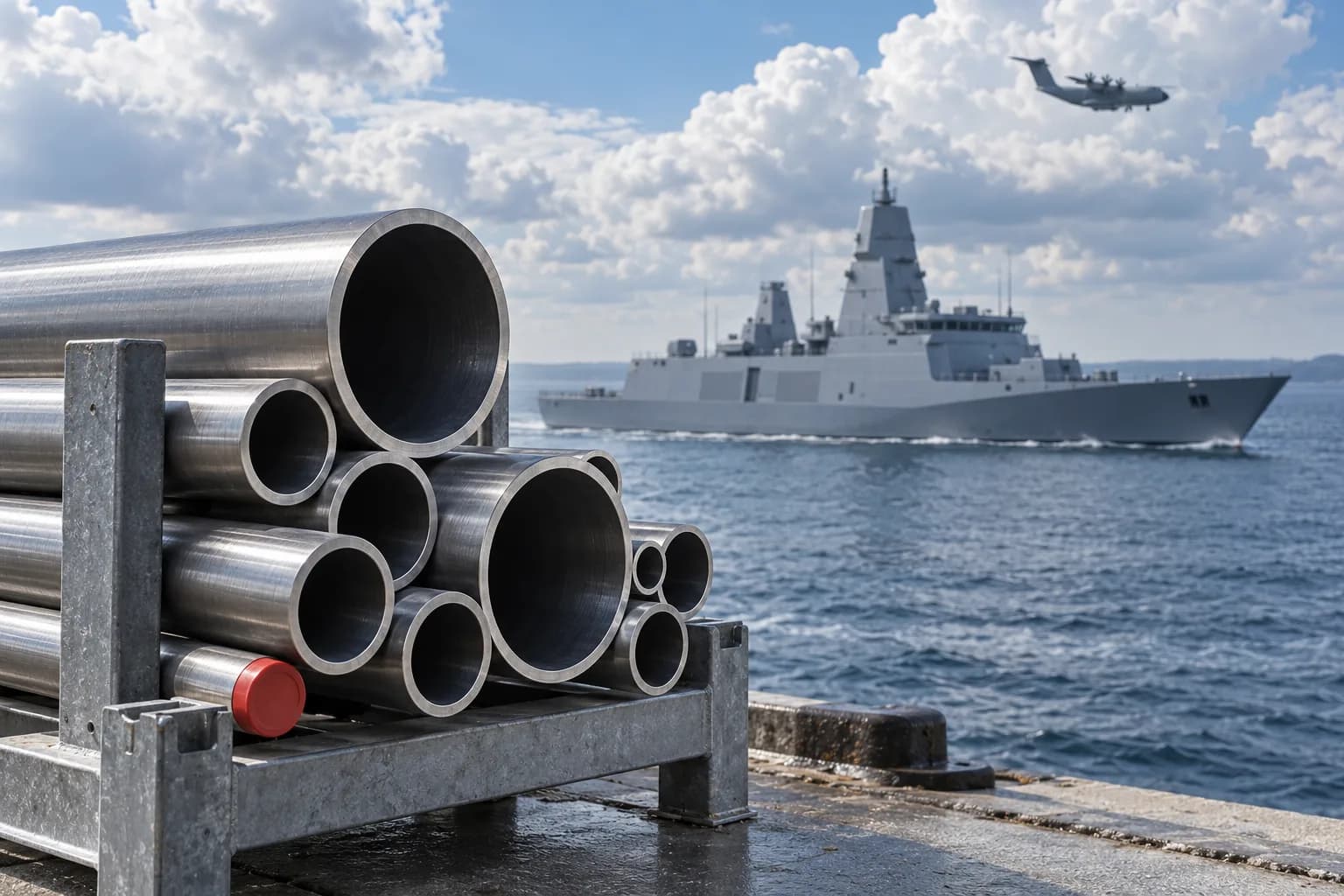
Europe is raising defence spending and expanding industrial capacity. According to data from the peace research institute SIPRI, arms imports by European states rose significantly between 2021 and 2025 compared with the previous five-year period, while Germany is among the world's largest arms exporters. At the same time, geopolitical uncertainty and fragile supply chains are putting European sources of supply back in focus.
For manufacturers and suppliers this means rising demand for materials that are available, qualified and approved for military use. Stainless steels play a bigger part than many people expect. The September issue of the trade magazine Stahlmarkt devotes a detailed article to the topic. We have summarised its key points for buyers and design engineers.
Key points
- Requirement profile: Military components have to withstand corrosion, salt water, chemicals, shock, continuous vibration and a wide temperature range, from the cold at high altitude to the heat at the engine.
- Approval before availability: For the German armed forces, the Technical Delivery Conditions (TL) define which materials may be used. For NATO projects, certification by the NATO Support and Procurement Agency (NSPA) is a prerequisite.
- Austenitic workhorses: 1.4301, plus 1.4401 and 1.4404 for higher chloride resistance, are the most widely used grades, for example in exhaust, fuel and hydraulic lines.
- Heat: The titanium-stabilised austenitic grade 1.4541 is heat resistant up to around 850 °C and is used for exhaust systems and engine components.
- Wear and load: Martensitic grades such as 1.4006 and 1.4021 and the precipitation-hardened 1.4542 cover parts that need high hardness, wear resistance and strength.
- Far beyond weapon systems: Field kitchens, catering equipment and medical supplies also rely on stainless steel for hygiene and ease of cleaning.
Why stainless steel under military conditions?
Stainless steel is used wherever corrosion, temperature and fatigue resistance are needed together with high strength and hardness. Moisture, salt water or aggressive chemicals must not compromise a component's reliability, any more than heavy shocks or continuous vibration. Under extreme environmental conditions the material has to keep its structural integrity and mechanical properties across a wide temperature range.
Add to that wear resistance under abrasive conditions and resistance to high pressure. Good forming and machining properties also make complex parts easier to manufacture. For specific naval and aviation applications, non-magnetic stainless steels are also of great importance. The range runs from vehicle components on water, land and in the air, through parts for weapons and armour, to infrastructure elements and electronics housings.
Certified materials only
The German armed forces, NATO and non-European armed forces rely on manufacturers and suppliers with certified products, processes and materials. Based on extensive testing, the German armed forces' Technical Delivery Conditions (TL) specify which materials, and therefore which stainless steel alloys, are approved for military use. For projects of NATO member states, NSPA certification is a prerequisite for supplying components, equipment or materials.
For the supply chain this means it is not enough for a material to be technically suitable. It has to be delivered to standard, tested and fully traceable.
Which grade for which job?
Depending on the application, austenitic, martensitic, precipitation-hardening and duplex stainless steels are used. The overview below summarises the grades and examples named in the Stahlmarkt article.
| Grade | Structure | Strength | Defence examples |
|---|---|---|---|
| 1.4301 (304) | Austenitic | Versatile standard, easy to process | General components, kitchen and catering equipment |
| 1.4401 (316), 1.4404 (316L) | Austenitic, Mo-alloyed | Higher resistance to chlorides | Exhaust systems, fuel and hydraulic lines, e.g. in the M1 Abrams main battle tank; springs and components for landing gear, launch systems and mounts |
| 1.4541 (321) | Austenitic, Ti-stabilised | Heat resistant up to approx. 850 °C | Exhaust systems and engine components, e.g. in the Eurofighter Typhoon |
| 1.4006, 1.4021 | Martensitic | High wear resistance and durability | Parts such as weapon barrels |
| 1.4542 (17‑4PH) | Precipitation-hardened | Very high strength | Structural parts and highly stressed components such as fasteners |
Whether a grade is approved for a specific project is determined by the applicable TL or the customer's specification.
Small arms show how demanding the conditions can be. In the German armed forces' standard G36 rifle, the gas piston is made of pressure- and heat-resistant stainless steel because it is directly exposed to hot propellant gases. The barrel sits in a glass-fibre-reinforced plastic housing but is protected against abrasion on the inside by stainless steel. Springs, bolt components and pins are also often made of stainless steel.
More than weapon systems: catering and medical
A large share of the stainless steel used by the military has nothing to do with weapons. For storing, preparing and serving food in field kitchens and barracks, the German armed forces rely on kitchen equipment, work tables, sinks and complete kitchen systems made of stainless steel. They meet current hygiene standards and work regardless of the weather. Soldiers' personal mess kit, from cup and plate to cutlery, is also made of stainless steel.
In medical equipment, the material is indispensable anyway thanks to its hygienic properties and ease of cleaning.
What this means for purchasing and design
- Clarify the specification first. Check early which TL, standards and approvals apply to your part. The right grade is the one that fits technically and is approved.
- Insist on traceability. Inspection certificates 3.1 or 3.2 to EN 10204 and an unbroken link from heat to delivery are mandatory in safety-critical supply chains.
- Plan for European availability. With rising demand and uncertain supply chains, stock material from European production shortens replacement lead times and reduces risk.
We stock seamless stainless steel tubes in standard austenitic grades such as 1.4301, 1.4404 and 1.4571, with inspection certificates to EN 10204 and traceability within our ISO 9001:2015 certified quality management system. Are you developing or manufacturing components for demanding operating conditions? Get in touch. We check your enquiry against the required specification.
Source: Ursula Herrling-Tusch, “Edelstahl für extreme Einsatzbedingungen” (Stainless steel for extreme operating conditions), Stahlmarkt 09/2026, p. 28 ff. (stahlbase.com). According to the article, the arms import figures are based on data from the Stockholm International Peace Research Institute (SIPRI). Summary and commentary: Schierle Siyaya GmbH.